
Bibracte, capital of the Aedui: a major site for understanding ancient Gaul

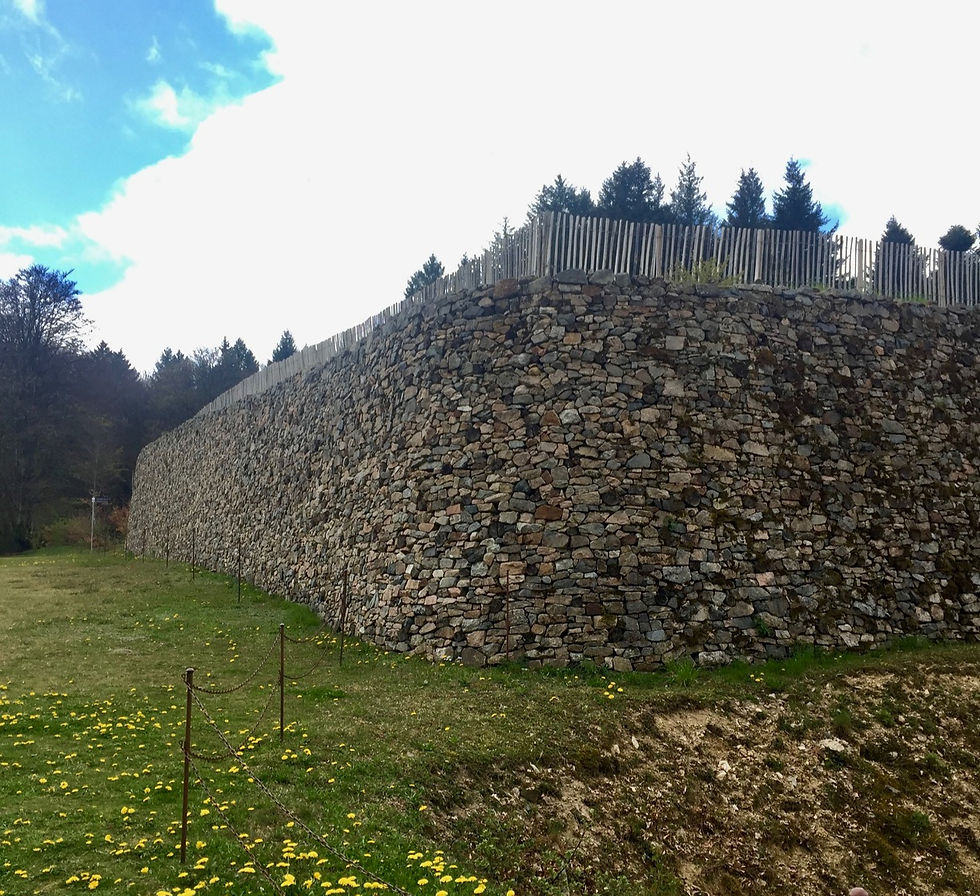
Located on the heights of Mount Beuvray, in the heart of the Morvan region, Bibracte occupies a special place in the European archaeological landscape. Former capital of the Gallic tribe of the Aedui, the site is now recognised as the best-known Gallic capital thanks to archaeology. This uniqueness is due to the continuity of research carried out over several decades, the extent of the preserved remains and the diversity of the periods represented, from the Iron Age to the Gallo-Roman period, through to more discreet medieval occupations.
Bibracte is not just a place of remembrance: it is a living site of research and transmission, and a visit here is inseparable from a visit to the Iron Age museum at the foot of Mont Beuvray.
A Gallic capital at the heart of the Iron Age
Bibracte became the capital of the Aedui tribe at the end of the Iron Age, mainly during the 2nd and 1st centuries BC. During this period, oppida – large fortified settlements – played a central role in the political, economic and social organisation of Gaul. The oppidum at Bibracte covered several hundred hectares and enjoyed a strategic position, dominating the traffic routes between the Loire, Seine and Saône river basins.
Ancient sources, notably Julius Caesar, mention Bibracte as a major centre of power. But it is mainly archaeological excavations that have made it possible to reconstruct its concrete reality: a dense, structured city with specialised districts, public spaces and a developed craft industry.
Exceptional remains, from the Iron Age to medieval times
One of the great attractions of Bibracte is the stratigraphic clarity of the site. The visible remains cover a long period of time, making it possible to trace the evolution of the site over more than a millennium.
For the Iron Age, archaeologists have unearthed monumental ramparts of the murus gallicus type, residential quarters, paved streets, craft workshops (metalworking, coinage, ceramics) and buildings used for political or economic purposes. These discoveries have profoundly changed our view of Gallic societies, long perceived as essentially rural and not very urbanised.
After the Roman conquest, Bibracte underwent a period of transition. Part of the population moved to the new town of Augustodunum (Autun), founded below. However, the site was not abandoned abruptly: Gallo-Roman occupation is attested, followed later by traces of medieval activity, showing that Mont Beuvray retained its symbolic and territorial importance over time.
Forty years of European excavations
Bibracte is also a leading scientific site. For over forty years, it has been the subject of European archaeological excavation programmes, bringing together researchers, universities and institutions from many countries. This continuity is exceptional in French archaeology.
The methods used – extensive excavations, environmental analyses, studies of artefacts, geophysical surveys – have enabled Bibracte to be approached as a veritable laboratory for Iron Age archaeology. The results are widely disseminated through scientific publications, databases and academic work, making the site an international reference for the study of oppida.
An inseparable archaeological and natural site
Bibracte is both an archaeological site and a protected natural area. Mount Beuvray, covered with forests and meadows, offers a landscape that contributes to understanding the site. The relief, forest resources and visibility over the surrounding area partly explain why the Aedui chose to establish their capital here.
This landscape dimension is now fully integrated into the site's promotion. The visitor trails allow visitors to discover the remains while exploring a preserved environment, where archaeology and nature complement each other.
The Bibracte Museum: understanding the Iron Age
A visit to the site is naturally complemented by a visit to the Bibracte Museum, which is entirely dedicated to the Iron Age. This site museum plays an essential role: it provides the keys to understanding the sometimes discreet remains visible on the ground.
Through clear and rigorous museography, the museum presents the objects discovered during excavations – weapons, tools, coins, ceramics – and places them in their social, economic and political context. It also addresses contemporary archaeological methods and major issues related to Gallic societies.
Far from clichés, the museum shows a complex Gaul, connected to the Mediterranean world, innovative and structured, in constant dialogue with Rome even before the conquest.
A key site for understanding Gaul
Bibracte occupies a central place in understanding Gallic history. Thanks to the extent of the remains, the quality of the research and the diversity of the periods represented, the site allows us to follow the evolution of a Gallic capital over a long period of time, from the Iron Age to the medieval reorganisations of the territory.
For Arko, Bibracte is an emblematic example of what archaeology can contribute to our knowledge of the past: not a static image, but a dynamic interpretation of ancient societies, embedded in a landscape and enriched by decades of research. It is an essential site for anyone who wishes to understand Gaul beyond the texts, through the very materiality of its remains.
Links
Official website of the Bibracte site: https://www.bibracte.fr/


Comments